Don’t Run Out of Spoons!

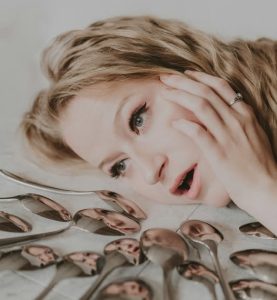
a woman is lying on her side looking tired.  she is facing an array of shiny metal spoons.  Her reflection is visible in each spoon.

As a family, we each have different needs and strengths. One constant aspect of our lives is planning ahead so that we don’t run out of spoons. This means being realistic about how much we can achieve each day, how much help we will need from each other, and how much recovery time we will need.

Spoon theory is a popular metaphor which describes our mental/emotional energy as a set of spoons. We have a finite amount of spoons each day and, when they are used up, we cannot do any more. Some activities use more spoons than others and we have to be careful not to use too many spoons early in the day and not leave enough for the necessary evening and bedtime routines. It is important to remember to pace ourselves not just in physical energy but also in our mental capacity and emotional reserves.

This weekend, I am going to attend the same event twice. Once with my family and caring for their needs and once by myself while they recover at home. We only came to this plan in the last few days when we tried a few things out and realised that we didn’t have the capacity as a family to do everything at once. This is why advance planning, collaboration and negotiation are such an important part of the PDA support toolkit. You will often end up adopting solutions that you would never have thought of yourself but, if they work for everyone, then they are not wrong!

Photo by Elise Wilcox on Unsplash

Thoughts about the medical model

the chest and arms of a man in a white medical coat holding a red stethoscope.

“Autism is A Medical Diagnosis.” I saw this statement posted recently and it got me thinking – is that all it is?

There certainly is a medical definition of Autism Spectrum Disorder. The current definition centres around difficulties with social communication, social interaction, and restrictive and repetitive behaviours. However, that definition has changed considerably since the term autism was first used and is continuing to change and adapt as the understanding of the broad spectrum of neurodiversity has grown. In recent years, much of that greater understanding has been led by neurodivergent people themselves rather than being led by academic research.

I believe there is much more to autism than the medical model. For a start, the medical model defines autism by “difficulties”. In this model, an autistic person is, by definition, beset by difficulties. The truth is that many autistic people are happy and thriving in their own unique way and in a supportive environment. They only have difficulties when they try to interact with a world that doesn’t understand, support, or accommodate their needs. This leads us to the social model of autism, which sees the environment around the autistic person as the issue, rather than the person. Change the environment to suit the person and the person no longer is beset with difficulties.

For example, many autistic people have a Gestalt learning style. This learning style is great for seeing the whole picture and intuition but it is not well suited to learning in a classroom or lecture setting. Gestalt learners often struggle with traditionally taught academic subjects but excel in more hands-on subjects. They often do much better when they research and teach themselves a subject rather than in a formal learning environment. Gestalt learning is not a disability. It is simply that they will do better in a Gestalt learning environment rather than a traditional audio/visual learning environment.

The world needs difference. Different perspectives and ways of viewing the world are essential to creativity and novel solutions to issues. We really need to learn to think of differences as important rather than as medical difficulties.

Photo by Online Marketing on Unsplash

Negotiations with a youngster

A garden scene. A toddler is taking an unsteady step while her mum and older brother are either side of her with their hands held out ready to catch or steady her.

As parents, we often struggle with the idea of collaborating and negotiating with a younger child. Traditional parenting techniques often equate negotiation with allowing the child too much control. Does this really make sense though?

How do we teach a young toddler? It is natural to engage in play and to support them as they try out new things. We hold their hands and steady them as they learn to put weight on their feet and begin to walk. As they progress, we let them take a few steps unaided but always ready to catch them or pick them up when they falter. We don’t force them into an adult world but rather we join them in their world and support them. Their natural curiosity and desire to learn is what drives them rather than anything we do. Yes, we can encourage them (a lot!) but they are very much in control of how much they learn and when.

As children reach school age, how we teach them changes. We adopt the school-based learning model where children have to learn what is set out for them on the curriculum. Whether they are interested or curious is no longer a factor. As a result, we end up having to introduce artificial motivators such as rewards and sanctions. As traditional parents, we accept that this is just how it has to be.

Really, though, there is no reason not to continue with a style that allows for natural curiosity and where you, as parent, join your child in their learning journey. A style where you collaborate together working towards a shared goal that you have negotiated. In fact, research shows that learning driven by autonomy and intrinsic motivation is much more successful than traditional teaching methods.

If this is true of learning, it stands to reason that it can be true in other areas of life as well. Teamwork makes the dream work!

Picture credit: freepik.com

Book Review: Understanding PDA for Kids and Grown Ups by Stacey Freeman and family

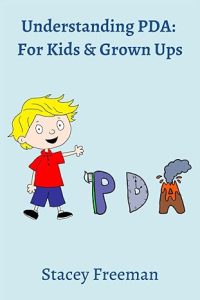
Front Cover of the book "Understanding PDA: For Kids & Grown Ups"

I love short and simple books that explain PDA in a way that anyone can read and understand. This little book is presented as an illustrated children’s book with only a couple of sentences on each page. Managing to cover all of the main points about PDA in such a small format is quite a feat but the author manages to do this and present an engaging story at the same time.

The story centres around a young boy, Ethan, and how he felt when his uncle wanted to take him to the park. Ethan wanted to go but the demands that his uncle was putting on him made it impossible for him. Mum tried to help and do do things in a non-demand way but uncle was not listening. In the end, mum has to ask uncle to leave. Many useful approaches and advice about how things feel to a PDAer are weaved into the narrative. I was really impressed by the amount of information covered in just 47 pages.

As the title suggests, this book is great for understanding the basics of PDA for both children and adults. It really is suitable for any age and the illustrations and simple format mean that it is very likely to get picked up and read; even by those who would normally resist reading a book about any ND condition.

Understanding PDA for Kids and Grown Ups is available in paperback or Kindle format from Amazon. Using the link below will ensure that the PDA Society receives a small commission from Amazon on the book sale.

Buy from Amazon

Coping at large events

 a young woman near the front of a crowded place. She has her eyes closed, her head facing upwards with an expression of joy. Her arms are raised in the air and making a heart symbol with her fingers. She appears to be quite happy within herself regardless of those around her (none of whom have their hands in the air)

Recently, we attended a multi-day event with large crowds. How did we cope with PDA? By doing things differently, of course!

First of all, planning. We were fortunate to be invited to volunteer at the venue while the event was being set up. This gave us a chance to scope the place out, discuss our plans in the context of the venue itself, and befriend some of the stewards who then went out of their way to help us when they saw us on the event days. In particular, we wanted to identify some likely quiet areas we could use for retreat and recovery.

At home, we have “packing lists” of all of the items we have found helpful at similar events. This helps to make sure we don’t forget anything we might want. For this event, we knew from previous years to bring personal FM radios because the event audio is broadcast locally so you can hear it in parts of the venue that don’t have good PA. We also packed plenty of sensory and regulating items: fidgets, blankets, cuddles, and massage brushes.

Possibly most importantly, we didn’t plan to arrive on time. We got up and dressed leisurely and arrived when we were ready. Most days, when we arrived, we stayed in the car for a while with a drink and a snack to recover from the journey before venturing into the venue.

We took breaks whenever we wanted to. We used the car as a base. We had a picnic table and chairs that we were able to discretely set up in the car park without getting in the way of other traffic and we had plenty of food and drinks in the car.

Inside the venue, we identified quiet spots. Sometimes we sat on the edge of the main crowd. At other times we took advantage of the special needs provision and sat in one of the large lounges or a designated quiet area. Our favourite area was an open-air balcony usually reserved for wheelchair users and their families. At this event, the balcony was open to all but not many found it. We generally shared the area with only one or two other families and this gave us the perfect balance between being out in the main stadium but, at the same time, maintaining a personal space and separation from the crowded areas. Another advantage was that we could do whatever we needed to keep regulated without disturbing others in the crowd.

Finally, when the event was over, we took time off. It took our PDAer about a week to recover her energy levels and we didn’t plan anything for her during this time.

Don’t be afraid to stand out from the crowd. Instead, embrace the difference and be happy to achieve your goals in your own unique way.

Photo by Alfonso Scarpa on Unsplash

What do we want to achieve?

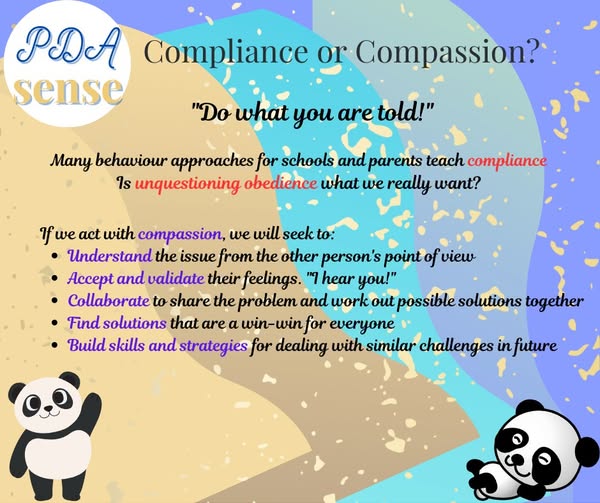
a slide with the following text;
Compliance or Compassion?
"Do what you are told!"
Many behaviour approaches for schools and parents teach compliance
Is unquestioning obedience what we really want?
If we act with compassion, we will seek to:
Understand the issue from the other person's point of view
Accept and validate their feelings. "I hear you!"
Collaborate to share the problem and work out possible solutions together
Find solutions that are a win-win for everyone
Build skills and strategies for dealing with similar challenges in future

Do we want to raise children who are unquestioningly obedient or do we want something more? Most traditional parenting and school behaviour approaches focus on compliance – getting kids to do what they are told – ideally without question or delay. However, being obedient is not usually good for adults. In fact, such “people pleasing” can make someone vulnerable to bullying and abuse.

If we want to build skills for the future, then we should model adult strategies for negotiation, collaboration, and problem-solving from an early age. Doing so empowers children and respects their autonomy. It allows us to better understand and validate their feelings. And, it is a win-win for everyone – we are all working together towards a shared goal. Most of all, it is compassionate.

Image copyright 2023 PDA Sense

Is PDA part of Autism?

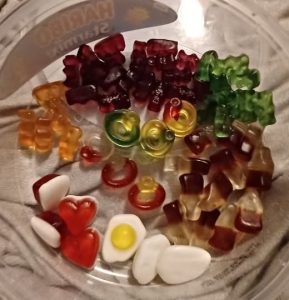
a tub of mixed gummy sweets that have been carefully sorted and separated into their different types

When we first learned about PDA, it seemed very different to the sterotypical view of autism that we thought we knew. Our daughter is very expressive (in her own way) and can mask her way through a social situation pretty well. She makes eye contact (with people she trusts) and doesn’t line up her toys or sit in the corner rocking.

Actually, that last part is not really true. She does rock. She also bounces and spins but we didn’t really notice because she did these as part of play. Also, she may not line up toys but she will spend time sorting and separating a sweet assortment before eating them.

As we learned to look beneath the surface, we began to see more and more. Yes, she can be very expressive and she can be absolutely charming in polite company but these are role-playing. Her understanding of social nuances was, and still is, much less than her surface behaviour would indicate. Over time, we have come to see that she has all of the challenges of the triad of autsim. It is just that she doesn’t always display these difficulties in the stereotypical way. We also began to realise that a lot of our stereotypical beliefs about autism were just plain wrong. It is when we learned to recognise these more subtle nuances that we really began to learn how to understand our daughter.

The autism community that we have now is awesome! We have learned so much about the actual lived experience of PDA that we would never have learned from a clinic or a medical textbook. I am truly grateful to those with real lived experience of PDA who share their experience so willingly, freely and with so much passion. Thank you.

What I have found is that the key to understanding PDA lies beneath the surface. PDA is not about the behaviour that you see. It is about the thought processes and emotional reactions that underpin the behaviours. Keep building that bond of trust and learning what is going on underneath.

Image copyright PDA Sense.

Can you help?

a lady pushing a pram past a wall with a multi-coloured mural. The mural features two raised hands and the words “The best gift is you!”

Sometimes, we feel that we have nothing left to give. Often, at these times, someone comes along and gives us just a little helping hand; just enough that we can make the next step, and then the next one. More often than not, that someone is a volunteer. They are giving their time freely to help others.

There are many ways to volunteer. Some people probably don’t even realise they are volunteering. Perhaps they answer a couple of posts in a support group, or maybe they just ring a friend and give them a listening ear. Others take volunteering very seriously; almost like a job except without pay. However you do it, if you give your time freely for other people, you are a very special person and Volunteer’s Week is a time for saying “Thank You!” to all of you. We all really appreciate you!

If you would like to volunteer but are not sure where to start, please do take the next step. You don’t have to do much. Just a few minutes can be enough to make a real difference. You also don’t need any special skills or experience. Just do what you enjoy. If you want to help the PDA community, then there are some great suggestions at https://www.pdasociety.org.uk/get-involved/

Photo by Dakota Corbin on Unsplash

Will my child be successful?

 a person in silhouette against a bright sunny background. The person is standing in a victory pose with one arm held high.

For most parents, our goal is to raise our children to become successful adults. When we first realise that our precious little one may be autistic, it can come as a shock. Emily Pearl Kingsley described the feeling very well in her essay “Welcome to Holland”:

‘It’s like planning a fabulous vacation trip – to Italy. You buy a bunch of guidebooks and make your wonderful plans. The Coliseum. The Michelangelo David. The gondolas in Venice. You may learn some handy phrases in Italian. It’s all very exciting. After months of eager anticipation, the day finally arrives. You pack your bags and off you go. Several hours later, the plane lands. The flight attendant comes in and says, “Welcome to Holland.” “Holland?!?” you say. “What do you mean Holland?? I signed up for Italy! I’m supposed to be in Italy. All my life I’ve dreamed of going to Italy.” ‘

https://www.emilyperlkingsley.com/welcome-to-holland

As we adjust to what it means to be autistic, we may well have to abandon some of our plans and dreams for the future. It is natural to mourn the loss of those, but it is also important to realise that our new plans and dreams are not better or worse than the old ones; they are just different. To answer the question “Will my child be successful?”; we must first work out what success looks like for our child. The media would have us believe that success is defined by fame and fortune. They portray the rich and famous lifestyle as the ultimate form of success. The truth is that many rich and famous people are unhappy. Really, success comes in many different forms. Some people enjoy performing on stage and dream of performing to a crowded stadium of fans. For others, being put in this situation is the stuff of nightmares.

What dreams and goals would make your child happiest? Perhaps it is raising a family of their own. Maybe it is pursuing a passionate interest in the environment or wildlife and becoming a renowned expert in their chosen field. Perhaps becoming an outspoken advocate for the autistic community (or another community) is their goal. They may want to become an artist, a programmer, an entrepreneur or an athlete. You can find examples of successful autistic role models in all of these fields and more.

Being autistic is no barrier to success. In fact, some autistic traits such as hyper-focus and tenacity are the keys to success in some fields. At the end of the day, though, isn’t it best to define success as the things that make someone happiest?

Photo by Miguel Bruna on Unsplash

What will you choose?

a young boy in front of a drinks vending machine. He is trying to choose from all the options available.

Does that question make you anxious? Many neurodiverse people report difficulties in decision-making. It can be exhausting, overwhelming and anxiety-provoking. Decisions can be particularly difficult if they need to be made quickly, involve talking to others (especially strangers), or involve a change of routine.

Choosing from a menu in a restaurant might raise all three of these flags. Having a meal out is usually a treat rather than part of normal routine. The waiter gives you a limited time after seating you before asking for your choices and you are then expected to tell him what you have chosen. If the menu is a long one, another factor might come into play: options paralysis.

Choosing one option from a long list requires you to reject all of the other options. What if one of the other options is actually better? How can you possibly analyse and evaluate all of the options in the given time? In the fable of the Fox and the Cat, the fox boasts of having many tricks and dodges to escape danger while the cat has only one. When the hunters arrive with their dogs, the cat quickly climbs a tree but the fox spends his time deciding which trick to use and ends up caught.

How can we help? One technique I use with my daughter is to offer her only two or three choices from the menu. This helps her to break the problem down. She is still free to choose something that I haven’t suggested (and often she does). Her choices are not restricted but rather broken down into smaller, more manageable, chunks. In the same way, we can take a large decision and look at it one step at a time. Would you prefer pizza or pasta tonight? Pizza. OK, do you want a meaty one or a veg one? Meat. OK, how about chicken or beef? Ham. OK, do you want pineapple with that? Actually, I want spaghetti Bolognese; just like last time. Great! Do you want to tell the waiter, or shall I?

Photo by Egor Myznik on Unsplash

Wordpress Social Share Plugin powered by Ultimatelysocial